Watch The Video Below To Learn How a Board-Certified Integrative Medicine Specialist Helps High-Performers Address Brain Fog, Anxiety, and Insomnia in 90 Days
How To Get A Complete Brain Map That Shows Exactly What's Dysregulated And Build A Personalized 90-Day Plan To Retrain Your Brain Without Prescription Medications Or Lifestyle Overhauls
Disclaimer: For educational and informational purposes only; not medical advice, and individual results are not guaranteed.
Brain Breakthrough Session
Once you request your session, a member of our staff will reach out to schedule you. From there, you'll come to our Charlotte clinic for your HRV assessment and full qEEG brain map. Within 72 hours, we process your results and build your personalized analysis report. Then you come back for a 60-minute consultation where we walk you through everything.

By providing us with your information you are consenting to the collection and use of your information in accordance with our Terms of Service and Privacy Policy.
Join Over 4,500+ Patients We've Helped at VYVE Wellness
As Seen On....





















CLEAR ANSWERS WITHIN WEEKS

ONLY 40 MINUTES PER WEEK

PHYSICIAN-GUIDED PROTOCOLS

OBJECTIVE 19-REGION BRAIN DATA
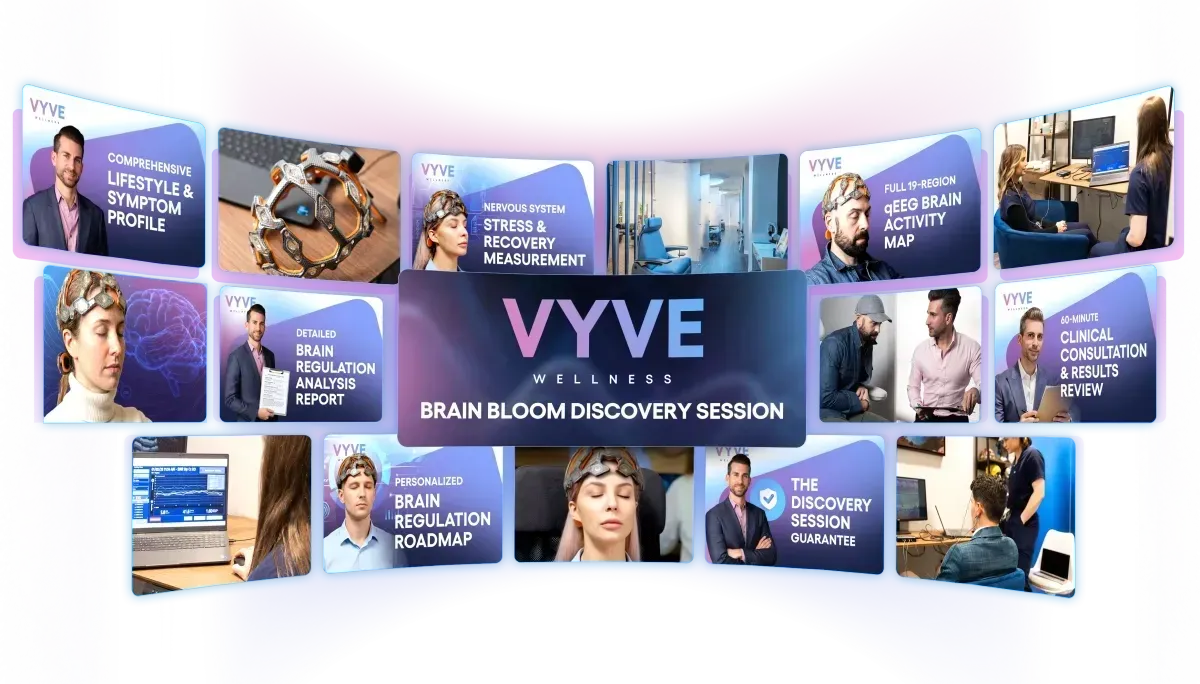
HERE IS WHAT I AM GIVING YOU..
The 3 Major Parts Of The Brain Breakthrough Session
Step 1: Complete Diagnostic Assessment
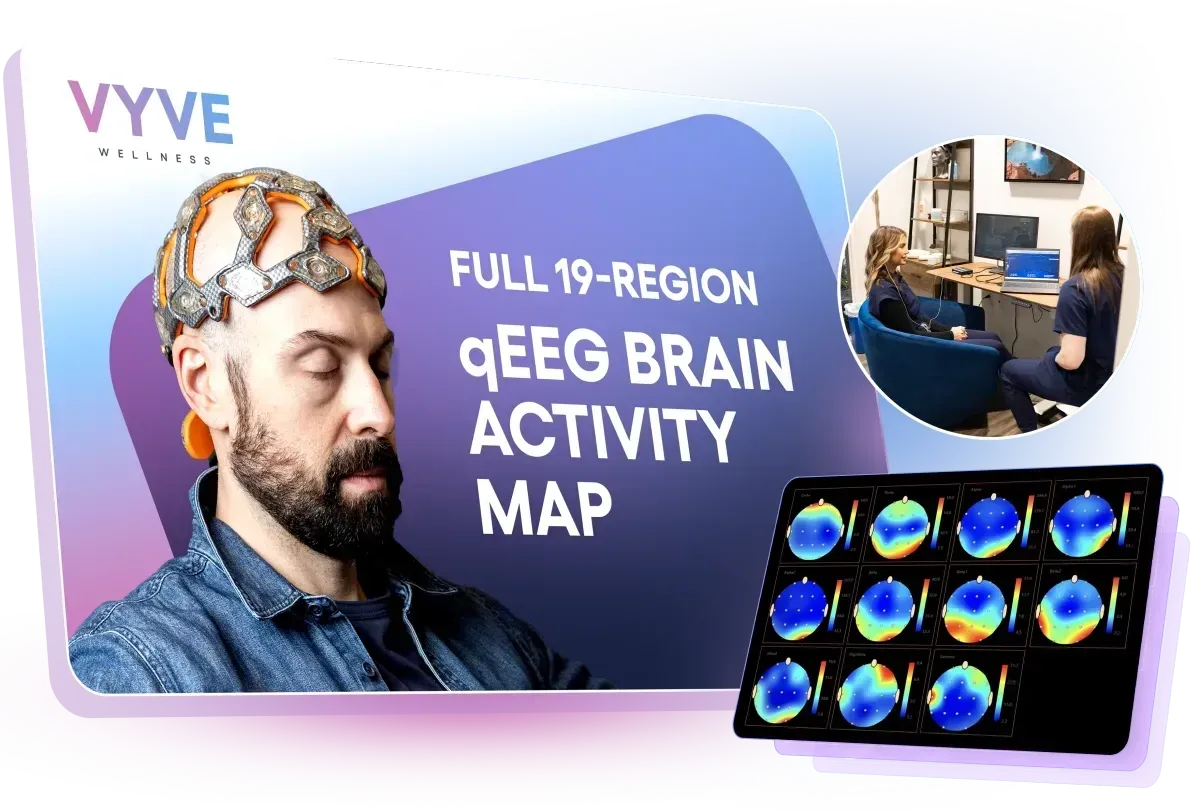
We start by capturing the full picture of what you're experiencing day to day, including your sleep quality, mood patterns, focus and energy levels, and stress triggers. From there, we run a real-time Heart Rate Variability measurement that tells us objectively how activated or depleted your nervous system is. And then we complete your full 19-region qEEG brain map, which reads electrical activity across all the major areas of your brain and produces a color-coded visual showing exactly which regions are overactive, underactive, or firing out of rhythm.

Step 3: Personalized Roadmap and Guarantee
Based on the convergence of all three diagnostic inputs, your clinical team builds a prioritized roadmap identifying the top patterns to address first, the specific neurofeedback training targets that correspond to those patterns, and the supporting therapies that could accelerate results. You'll see how each recommended step connects to a specific finding in your data. Whether you move forward with the full Brain Bloom protocol or not, you leave with a clear, personalized picture of what your brain needs.
Step 2: Detailed Analysis and Clinical Consultation
We take your raw brain data and translate it into a clear breakdown of what's going on in your attention networks, your stress regulation patterns, and your sleep-related rhythms. You'll see your dominant dysregulation profile, how each pattern connects to what you've been experiencing, and what would need to change first. From there, you sit down with our clinical team for a full 60 minutes and we walk you through every finding in plain language.

Step 2: Detailed Analysis and Clinical Consultation
We take your raw brain data and translate it into a clear breakdown of what's going on in your attention networks, your stress regulation patterns, and your sleep-related rhythms. You'll see your dominant dysregulation profile, how each pattern connects to what you've been experiencing, and what would need to change first. From there, you sit down with our clinical team for a full 60 minutes and we walk you through every finding in plain language.
Step 3: Personalized Roadmap and Guarantee
Based on the convergence of all three diagnostic inputs, your clinical team builds a prioritized roadmap identifying the top patterns to address first, the specific neurofeedback training targets that correspond to those patterns, and the supporting therapies that could accelerate results. You'll see how each recommended step connects to a specific finding in your data. Whether you move forward with the full Brain Bloom protocol or not, you leave with a clear, personalized picture of what your brain needs.

Hear What Clients Are Saying About The Brain Breakthrough Session...
Individual results may vary. These outcomes reflect patients who followed the full protocol as directed.
OUR OFFER TO YOU
When You Request Your Brain Breakthrough Session Today, You're Going To Get:
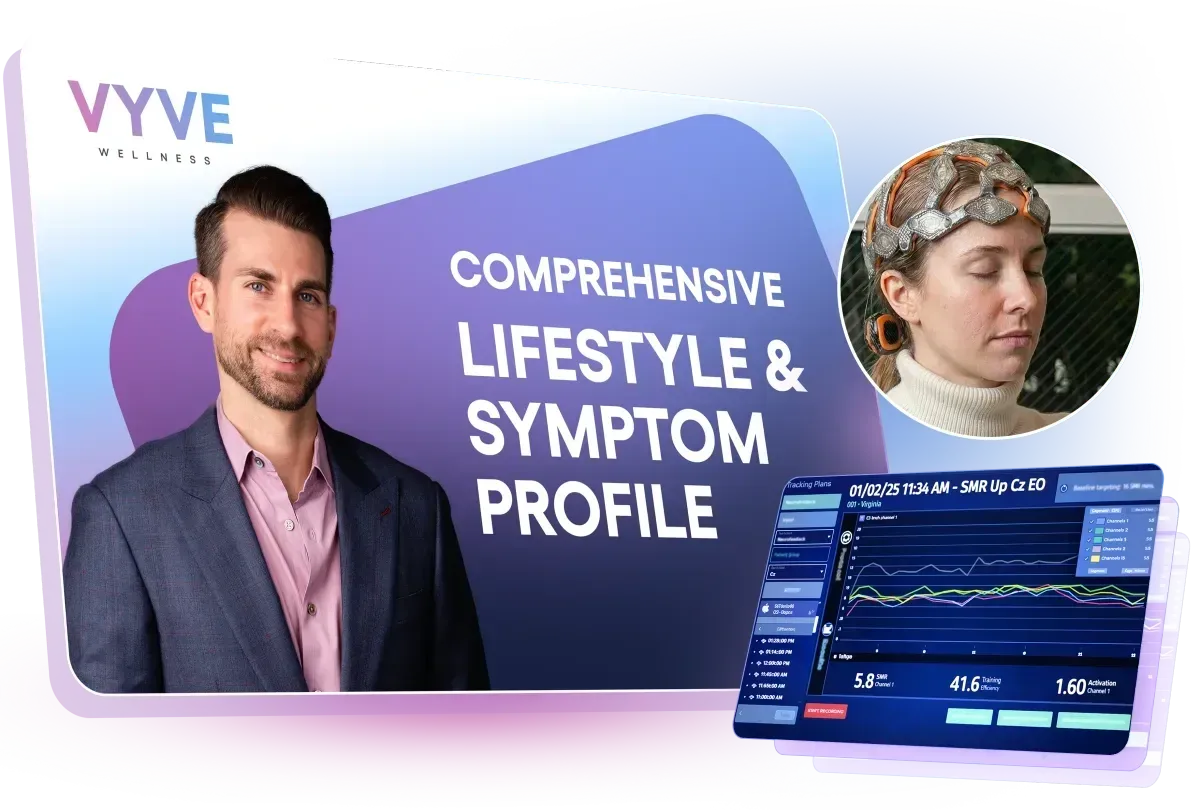
Comprehensive Lifestyle and Symptom Profile
Captures the complete picture of your sleep, mood, focus, energy, and stress patterns
Organizes scattered symptoms into a coherent clinical picture that guides your entire program
Replaces the typical five-minute conversation with a thorough, structured assessment
Gives you a baseline so you and your clinical team can track real changes over time
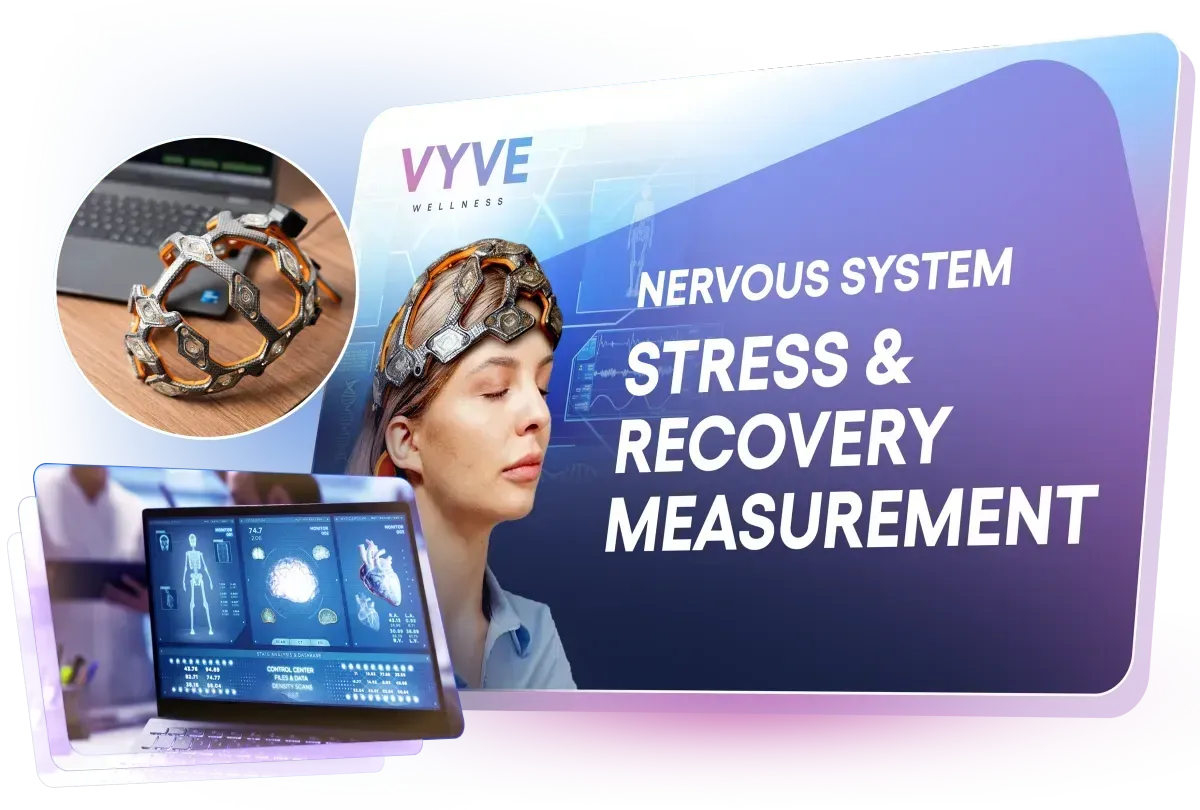
Nervous System Stress and Recovery Measurement
Measures the balance between your stress and recovery systems using Heart Rate Variability
Converts what you've been feeling into an objective number your clinical team can work with
Takes about 5 minutes and is completely non-invasive, so it fits into any schedule
Tracks over time so you can see your nervous system learning to regulate as training progresses
Full 19-Region qEEG Brain Activity Map
Reads electrical activity across 19 regions and compares your patterns to normative data
Produces a color-coded visual report showing where dysfunction lives in your brain
Identifies which networks are overactive, underactive, or firing out of rhythm
Measures all your frequency bands including delta, theta, alpha, and beta across key networks
Detailed Brain Regulation Analysis Report
Breaks down your attention networks, emotional regulation patterns, stress response, and sleep architecture
Translates raw brain data into language you can understand and your care team can act on
Shows your dominant dysregulation profile and how each pattern connects to your specific symptoms
Becomes the roadmap your clinical team uses to build your personalized training protocol
60-Minute Clinical Consultation and Results Review
A full 60-minute session where your clinician walks you through every region of your brain map
Connects each finding to what you've been experiencing so you understand the "why" behind it all
Explains why past approaches may not have addressed the root pattern driving your symptoms
Gives you enough time to ask every question and leave with complete clarity

Personalized Brain Regulation Roadmap
Identifies the top brainwave patterns to address first based on your combined diagnostic data
Maps specific neurofeedback training targets to each finding so you see how it all connects
Includes supporting therapies that could accelerate results alongside the core training protocol
Gives you an estimated timeline and expected outcomes based on your specific patterns

The Discovery Session Guarantee
If our assessment cannot identify any dysfunctional patterns, we refund your investment in full
In seven years, we've never mapped a brain with these symptoms and found nothing
Eliminates the lowest-barrier concern of paying and learning nothing from the experience
Your only risk is spending the time to come in and get measured
All of This is Included When You Request Your Session Below
Join The Thousands Of Patients Who Have Gotten Clear Answers About Their Brain
Your journey to getting real answers about your brain fog, anxiety, and sleep issues starts with requesting your Brain Breakthrough Session below.
Brain Breakthrough Session
Once you request your session below, a member of our staff will reach out to schedule you. You'll then come to our Charlotte clinic where we complete your HRV assessment in about 5 minutes and your qEEG brain map in about 30 minutes. Over the next 72 hours, we process your brain map, compare it to normative databases, and create your personalized analysis report. You then come back for your 60-minute results review where we walk you through everything.
$195
We only accept 5 new Brain Breakthrough Sessions per month because each brain map requires 3 to 5 days of careful analysis and interpretation by our clinical team.
Get Measured. Get Answers. No Conditions.
If we can't identify clear patterns of dysregulation in your brain map, we refund your entire investment. We can offer this because in seven years of mapping brains with anxiety, brain fog, and insomnia, the patterns have shown up every time. So by requesting your session today, you have zero financial risk. Either we find dysregulation and you get a clear plan, or you get your money back.

IMMEDIATE CONFIRMATION

FULL REFUND IF NOTHING FOUND

SECURE BOOKING
Frequently asked
questions
Here are the answers to the most commonly asked questions about the Brain Breakthrough Session.
What exactly is the Brain Breakthrough Session?
It's a complete diagnostic assessment that combines a comprehensive symptom profile, a Heart Rate Variability measurement, and a full 19-region qEEG brain map. We take all that data, build a detailed written analysis, and then sit down with you for 60 minutes to walk through what the patterns mean for your specific situation. You also get a personalized brain regulation roadmap based on what we find. So instead of another conversation and another prescription, you see what's happening in your brain, measured and explained in plain language.
How is this different from what my doctor does?
Most doctors diagnose anxiety, brain fog, or insomnia based on a conversation and a checklist, and then prescribe medication based on that assessment. They're typically measuring blood chemistry, thyroid, vitamin D, and cortisol. But they're not measuring the electrical activity in your brain. We use a qEEG brain map that reads your brainwave patterns across 19 regions and compares them to normative data.
What does the qEEG brain map measure?
It measures electrical activity across 19 regions of your brain and compares your patterns to normative databases. We look at all your frequency bands, including delta, theta, alpha, and beta. We check balance between regions and coordination across your key networks for attention, emotion, sleep, and stress. The result is a color-coded visual that shows exactly which areas are overactive, underactive, or firing out of rhythm. It's non-invasive and takes about 30 minutes where you sit with your eyes closed.
How long does the whole process take from booking to getting my results?
You'll come in for your first clinic visit where we complete the HRV assessment in about 5 minutes and the qEEG brain map in about 30 minutes. Over the next 72 hours, our team processes and analyzes your data. Then you come back for your 60-minute results review where we walk through everything and build your personalized roadmap. So from first visit to having your full results explained, you're looking at roughly one to two weeks depending on scheduling.
I've been told my labs are normal. Why would a brain map show something different?
Lab work measures blood chemistry. It tells you about thyroid function, vitamin levels, cortisol, and similar markers. But brain fog, anxiety, and insomnia can stem from brainwave dysregulation, which is an electrical pattern issue, not a chemical one. For patients who've been told "your labs look normal" while feeling anything but, the brain map is often the first time anyone has measured what's going on at the level of the brain itself. The two aren't contradictory. Your chemistry can look fine while your electrical patterns are kind of stuck in the wrong state.
Is neurofeedback the same as biofeedback?
They're related but not the same. Biofeedback measures things like heart rate, muscle tension, and skin temperature. Neurofeedback specifically targets brainwave activity and works by training your brain to produce healthier patterns in the regions where we've identified dysregulation. We use the data from your qEEG brain map to create training protocols that are specific to your patterns. So it's a targeted approach based on what your brain needs rather than a general relaxation technique.
What does a neurofeedback training session look like?
It's as simple as watching your favourite television show. You sit in a chair, we place sensors on your scalp, and you watch a screen for about 20 minutes. The software reads your brainwave activity in real time and gives your brain feedback when it produces the patterns we're training for. You don't have to do anything actively. Your brain does the work. We typically recommend two sessions per week for 8 to 12 weeks, which comes out to about 40 minutes a week.
How quickly will I notice changes?
Most patients start noticing shifts after about 10 to 12 sessions, and more lasting changes tend to develop after 20 to 30 sessions. The first things people usually notice are improvements in sleep quality and fewer racing thoughts. From there, you kind of start to see better concentration, more stable mood, and less reactivity to stress. Everyone's patterns are different, so your clinical team will give you a more personalized timeline based on your specific brain map.
Are the results from neurofeedback long-lasting?
The training process works through neuroplasticity, which means your brain is forming new patterns that become its default over time. Think of it sort of like building a new habit at the level of your brainwave activity. Once those patterns are established through enough training, they tend to stick. We also support the process with things like peptide therapies and targeted nutrient support that help the training hold and accelerate results.
What if the brain map comes back normal and nothing shows up?
If our combined assessment cannot identify any dysfunctional patterns contributing to what you're experiencing, we refund your investment in full. We can offer this because in seven years, we've never mapped a brain with anxiety, brain fog, or insomnia and found nothing wrong. The patterns show up every single time. So the financial risk to you is basically zero. Either we find clear dysregulation and you get a plan, or you get your money back.
I've tried therapy, medication, and supplements with limited results. Why would this be different?
Therapy, medications, and supplements are all aimed at brain chemistry, behavior, or general wellness. None of them measure or directly target the electrical activity in your brain. If the root issue is brainwave dysregulation, those approaches may manage symptoms without addressing what's driving them. The brain map gives us objective data about which patterns are off, and the neurofeedback training targets those specific patterns. That's the piece most people have been missing.
Is this safe? Are there side effects?
The qEEG brain map is completely non-invasive. You sit with a cap on your head and sensors read your brain's electrical activity. Neurofeedback training is also non-invasive. It doesn't put anything into your brain. It reads your brainwave activity and provides real-time feedback. Most patients describe sessions as relaxing. The main thing we ask is that you commit to the training schedule so your brain has enough repetition to form the new patterns. Your clinical team monitors your progress throughout and adjusts protocols as needed.
I'm really busy. How much time does this take each week?
The neurofeedback training can be done in as little as 40 minutes a week, which is two 20-minute sessions. Obviously the more sessions you can do, the faster things can progress, but 40 minutes a week is the minimum kind of investment time that we've seen produce real changes. For high-performing professionals who already have packed schedules, we designed the process to require the least amount of time possible for the biggest impact on how you feel and perform.
Do I need to stop my current medications before starting?
No. We don't ask you to stop anything before we assess you, and we wouldn't recommend changes to your medication without proper clinical coordination. The brain map gives us a picture of what's happening in your brain right now, including while you're on medication. From there, your clinical team can work with your existing providers if any adjustments make sense down the road. The goal is to add a tool that addresses a system nobody else has measured, not to take away something that may be helping.
What credentials does the clinical team have?
Dr. Will Haas is a board-certified integrative and cellular medicine specialist and the founder of VYVE Wellness in Charlotte, North Carolina. He's been featured in major media outlets including Men's Journal, Men's Health, Women's World, Yahoo, and Medscape, and has done medical journalism at ABC News. Over the past 8 years, he's helped over 4,500 high-performers with these kinds of symptoms. The neurofeedback sessions are administered by trained technicians, which removes the physician bottleneck and allows us to see more patients without compromising quality.
Can this help with ADHD or focus issues specifically?
Focus and concentration issues often show up on a brain map as underproduction of alpha and sensorimotor waves in the frontal regions. When those frequency bands aren't firing at the right levels, your brain's executive function network can't sustain attention or regulate emotions properly. The brain map will show us whether that pattern is present in your case, and the neurofeedback protocol would be targeted specifically to those regions and frequencies. We don't diagnose ADHD through the brain map, but we can identify the electrical patterns that are often associated with those symptoms.
I live outside Charlotte. Can any of this be done remotely?
The brain mapping and HRV assessment need to happen in our Charlotte clinic because they require specialized equipment and clinical oversight. Some patients fly in from other states and even internationally to work with us. The initial visit takes about an hour, and then the results review can be done in person or potentially discussed remotely with your clinical team. If you're traveling in, we can often schedule the initial assessment and the follow-up results review within a few days of each other to minimize trips.
What happens after the Brain Breakthrough Session if I want to move forward?
If moving forward with your personalized protocol makes sense, most clients come in twice per week for 8 to 12 weeks. Your sessions are based on the specific training targets identified in your brain map and roadmap. We track your progress throughout, including repeat HRV measurements, so you can see your nervous system responding to the training. If it doesn't feel right, no problem. You still walk away with clarity about what's been happening inside your brain.
What if I'm not sure this is for me yet?
That's completely fine. We built the Brain Breakthrough Session specifically as a starting point that gives you real data without a long-term commitment. You'll walk away with an objective picture of what's happening in your brain, a clear analysis, and a roadmap. Whether you move forward with the full Brain Bloom protocol or not, you leave with a personalized picture of what your brain needs. And if we can't find anything, you get your money back.
How do I book and what happens right after I pay?
Once you request a session, a member of our staff will reach out to schedule you. Then you come to our Charlotte clinic on your scheduled date. We handle the HRV assessment, run the brain map, and have your analysis ready within 72 hours. After that, you come back for your 60-minute results review. The whole process from booking to having your full results explained typically takes one to two weeks.

ARE YOU:
The Action Taker
Disclaimer: The information on this page and in the video is for educational and informational purposes only and is not a substitute for professional medical advice, diagnosis, or treatment. All services described are provided based on individual evaluation by a licensed healthcare professional at VYVE Wellness in Charlotte, North Carolina. Individual results vary based on each patient's unique condition, history, and response to treatment. Testimonials reflect the personal experiences of those individuals and should not be understood as a prediction of results. The refund guarantee applies only to the Brain Breakthrough Session and is based on clinical assessment findings. If you are experiencing a medical emergency, call 911.